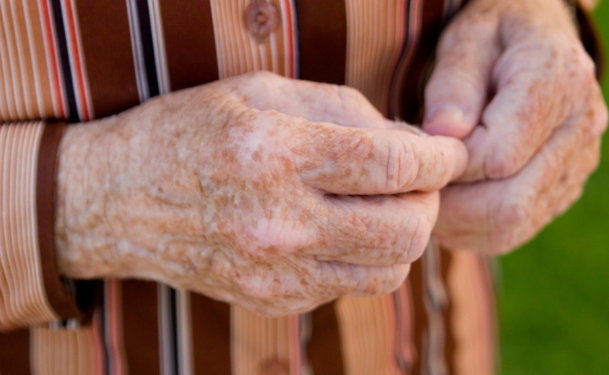
Age spots are also called sun spots and liver spots. Age spots are harmless brown flat spots that are commonly found on sun-exposed skin. They usually don’t appear until middle-age and occur in all nearly all skin types. Age spots are collections of a pigment (called melanin) that have accumulated in the top layer of the skin (the epidermis). Unlike freckles, which darken in the summer and fade in the winter, age spots do not fade.
What causes age spots?
Age spots increase with age and with increased sun exposure. They are more common in people who freckle and who burn easily. It is important to know that if you've had enough sun to develop age spots, you have a higher risk of developing skin cancer.
Are there any symptoms of age spots?
Age spots have no associated symptoms. However, if any of your age spots are changing or getting bigger, you may need further evaluation by your physician to rule out pre-cancerous or cancerous lesions.
What do age spots, sun spots and liver spots look like?
Age spots are flat and vary in size from a small pea to a dime. They usually are somewhat round and have irregular borders. They are found on chronically sun-exposed areas such as the shoulders, upper back, face, forearms, and the back of hands.
How is the diagnosis of age spots made?
Your physician can usually diagnose age spots based on their appearance. It is very important to distinguish age spots from melanoma (a form of skin cancer) which can look similar. Let your doctor know if a particular age spot is growing or changing. Sometimes, your physician may need to perform a biopsy to rule out skin cancer.
What treatment options are available for spot removal?
The best treatment for age spots is prevention. The key to preventing age spots is sun avoidance and daily sunscreen use. For example, you won’t find age spots on your inner thigh because of minimal or no sun exposure. However, for most of us, it is too late for prevention, and there are a number of treatment options available. Treatment options include FotoFacial/IPL treatments, laser resurfacing, bleaching creams and chemical peels.
Bleaching Creams
Over-the-counter creams contain 2 percent hydroquinone, a bleaching agent. Prescription creams may use single agents, such as Retin-A (tretinoin) or combinations of medications such as hydroquinone with tretinoin plus a cortisone cream.
Over the counter bleaching creams are usually well tolerated and may gradually lighten age spots over a couple of months. However, they are not very effective. Prescription formulations are often more effective but may have more side effects (such as redness, drying, and peeling) and are expensive. Creams may not work for everyone and the risks and benefits need to be discussed with your physician.
Chemical Peels
Your physician can administer a peel using a variety of different chemicals to remove age spots, discoloration, wrinkles and fine lines. Chemical peels may smooth and firm the skin and may lighten age spots gradually. The superficial peels, such as a glycolic acid peel can be done during your lunch hour, and there is no recovery time. Deeper peels are more effective but require longer recovery. See more details under discussion chemical peels.
Different kinds of peels carry different risks. Superficial peels are usually quite safe. However, you may need a series of superficial peels (done approximately once a month) before you'll notice improvement. Costs can add up if you choose a series of peels. The risks and benefits vary depending on the kind of peel need to be discussed in detail with your physician.
Laser Resurfacing
Laser resurfacing is an in-office treatment where age spots, wrinkles and lines are “burned” off with a laser. Laser resurfacing usually removes most age spots, age related discoloration, and wrinkles, often in just one treatment. Some lasers, such as the CO2 laser are considered the gold standard in terms of facial rejuvenation. With good sun protection, the effects can last up to five years. See more details under discussion of laser resurfacing.
Lasers actually remove the outer portion of the skin- called the epidermis. Because of this, you may experience some pain as well as redness and peeling. You may even form scabs in the days after the procedure. Expect recovery time of at least a week. Laser therapy is also expensive. One treatment can cost anywhere from $1,000 to $5,000, depending on how much of your face is treated. The risks and benefits of laser resurfacing need to be discussed in detail with your physician.
Intense Pulsed Light Therapy (IPL)
IPL is one of the newer forms of facial rejuvenation. Unlike lasers, which use intense, focused light, IPL is intense broadband light. Although IPL delivers energy to both the superficial and deep layers of the skin, the epidermis is spared from damage. Thus, there is virtually no recovery time. In the studies that have been performed so far, IPL can smooth the skin and fade age spots, freckles, melasma, and even broken blood vessels. Improvements usually last for about a year with good sun protection.
IPL is safer than laser therapy because IPL does not damage the epidermis. There may be some pain during the procedure but no recovery time. Unlike laser therapy, however, you may need multiple treatments (average is 4-6, at three weeks intervals) to get the full benefit. The cost is variable, but is usually more expensive than peels and less expensive than lasers. The risks and benefits of IPL therapy need to be discussed in detail with your physician.