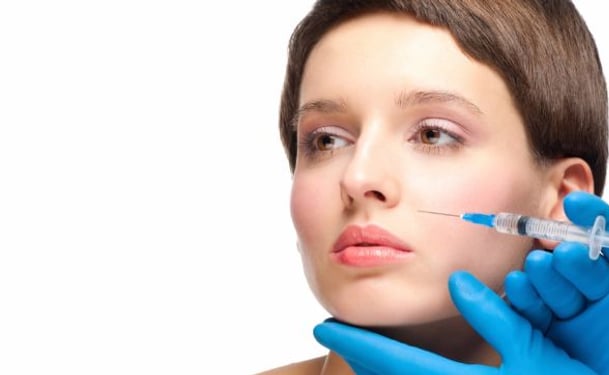
Dermal fillers are substances that are injected just below the surface of the skin to fill in lines, wrinkles, and scars. Unlike face lifts that stretch the skin, fillers add volume for a more natural youthful appearance. Fillers can also increase the fullness of the lips (see section on lip enhancement) and lessen the downward slant of the corner of lips. The most common areas treated are the smile lines around the nose and mouth, fine lines above the mouth, frown lines between the eyes, and acne scars.
There are two classes of dermal fillers
Permanent and temporary. The main permanent dermal filler in use today is silicone. There are a variety of temporary dermal fillers currently in use and several will be discussed below: Hydroxyappetite (Radiesse), hyaluronic acid (Restylane and Hylaform), sculptra, fat, and collagen. Temporary fillers are absorbed by the body over time, usually in 2-6 months and require repeated treatments to maintain the effect.
Silicone Dermal Fillers
The use of silicone fillers has been controversial in the past because of the risk of bumpy scars called granulomas that can form even decades after treatment. New formulations of silicone and new injection techniques have reportedly eliminated granuloma formation but long term studies are still in progress. The FDA has not approved silicone for this particular use. One advantage of silicone is you do not repeat treatments once the desired look has been achieved.
Collagen Fillers
Collagen is an abundant natural protein found in the body that provides structural support to skin, muscle, tendons and bone. In the skin, fibers of collagen are woven together to provide texture, resiliency and shape. Collagen is one of the substances lost during the normal aging process. Collagen injections are performed in an office setting and require no recovery time. They usually take less than an hour to perform. The main risk of collagen injection is an allergic reaction. Some of the collagen products are made from animals and require allergy testing prior to use (see below). The effect lasts between 3-6 months. Combinations of fillers are used to achieve a natural, full look.
Bovine (cow) collagen
Zyplast — Requires skin testing (for deeper wrinkles)
Zyderm — Requires skin testing (for fine lines)
Human (foreskin) collagen
Cosmoderm — No skin testing (for fine lines)
Cosmoplast — No skin testing (for deeper wrinkles)
Radiesse (Formerly called "Radiance")
Radiesse is made of a synthetic substance containing microspheres of calcium hydroxylapetite. There are no allergic reactions associated with this filler. With proper technique and local anesthesia, the injections are not very painful. There may be some bruising after the procedure but most patients return to normal activities the next day. One of the advantages of Radiesse is that it can last up to 3 years. Radiesse has been used for lip augmentation.
Restylane
Restylane is natural cosmetic dermal filler that is made of non-animal-based hyaluronic acid. The fact that it is non animal based decreases the risk of animal based disease transmission or allergic reaction. No pre-testing required. Restylane has been approved by the FDA for use in moderate to severe facial wrinkles and folds, such as nasolabial folds. There is usually no recovery after Restylane injection. The effect lasts approximately six months.
Hylaform
Hylaform is another hyaluronic acid based dermal filler that has recently been approved by the FDA for treatment of facial wrinkles. Hylaform is made from avian (bird) origin, and individuals who have allergies to avian products should not use this filler. It is believed that it last up to six months. It can be combined with bovine and non bovine type injections to address many parts of an aging skin.
Lipotransfer (fat)
This procedure is unique because it removes fat from one area of your body and transfers it to the area of concern. The main advantage of lipotransfer is that it eliminates the risk of an allergic reaction. Lipotransfer is a two step procedure. First, liposuction is performed using local anesthesia to collect the “donor” fat. Fat is then injected into the face, just below the second layer of the skin (dermis) or into the muscle. Bruising, swelling, and redness are common afterward and usually last a few days. No good studies have been performed to evaluate how long fat fillers last. Patients report variable results from 3 months to 3 years.
What are the risks of fillers?
Each filler is unique and has its own risk profile. In general, however, risks include allergic reactions, infections, pain, and scar formation. You should talk to your physician to decide if fillers are right for you. Fillers can be expensive and you may require repeat treatments.
How much do dermal filler treatments cost?
Fillers are expensive but the pricing varies depending on the number and types of areas being treated and the amount of filler material required. Treatments can range from several hundred to several thousand dollars. Remember that temporary fillers last at most 3-9 months.
How does Restylane work?
Restylane contains hyaluronic acid in the form of a crystal-clear gel. It is injected into the skin to lift the lip, wrinkle or fold. Once in your skin, it creates volume, resulting in a healthy and vital appearance. When injected into the lip it can restore a more natural and/or sensuous look. In contrast to other biodegradable implants, Restylane is not extracted from animals. This means no risk of allergic reaction. Therefore, it is perfectly safe to use instantly without pre-testing.
What areas respond the best to treatment?
Fine lines on the upper and lower lip that are not severe enough to require laser resurfacing smooth and fill nicely with Restylane. Deeper wrinkles and folds in the cheek areas (nasolabial, melolabial and lines at the corners of the mouth) also respond well using Restylane. Lip enhancement has up to twice the longevity of standard collagen implant treatments.
Is Restylane safe?
Yes. Hyaluronic acid occurs naturally in the body and therefore it also dissolves naturally with time and is integrated into your body?s tissues. The synthetic, biodegradable hyaluronic acid known as Restylane has been used in Europe and Canada for many years and is now approved in the United States. Your doctor will tailor your Restylane treatments according to the depth of the wrinkles and desired lip enhancement.
What are the treatments like?
The treatment is performed by injecting Restylane under your skin. Since no pre-test is needed, your procedure can usually be done in less than one hour. Many patients like the added comfort provided with an anesthetic cream, while others prefer an anesthetic block. This makes the treatment relatively painless.
How long does it last?
Depending on the area treated, most folds and wrinkles require one treatment. The repeat maintenance treatment is not usually required for approximately 6 months or longer. By experience these products last almost twice as long as regular collagen injections. The great thing about Restylane is that you can replenish your natural beauty whenever you feel the need. Unlike permanent implants, Restylane always leaves you a choice when the effect of the treatment has worn off. A touch-up can be performed any time you like after the previous treatment.
How will I look after my treatment?
Following your injections, normal activities can be resumed immediately. Discomfort is minimal. The treatment site may have a little swelling, which may last a few hours. There may be some slight bruising which can be covered with make-up. Depending on the area treated, correction can last up to six months or longer. If the lips are treated, initial swelling and tenderness may occur within the first several days, but subsides after two or three days.